
Hattiesburg City Directory Collections by Year
Surviving Hattiesburg directory volumes sit in four places rather than one. The Hattiesburg Library, the Hattiesburg Area Historical Society, the University of Southern Mississippi, and the Mississippi Department of Archives and History each hold pieces of the record. No single seamless run exists anywhere. Start with the year that matters to your question. Then ask that institution directly whether the specific volume, reel, or index is on hand. Ask whether it is usable too. A directory entry gives a solid date-and-place lead for a resident lookup. But it is not legal proof that someone owned or lived at a property.
| Collection | Years | Where Held | Access |
|---|---|---|---|
| Roger Chas B. Hattiesburg City Directory | 1905 | USM Mississippiana bibliography | Consult USM; a digitized page is not confirmed |
| Hattiesburg City Directory Co. | 1910 | MDAH/NPS bibliography | Confirm the requested year with MDAH or USM |
| R.L. Polk Hattiesburg City Directory | 1912 | MDAH Media Room | Microform, call MF/917.62CD/Hattiesburg/1912:v.1; not for loan |
| USM Hattiesburg City Directories | 1921 onward in the bibliography | USM Mississippiana | Check year-by-year physical or index availability |
| Polk Company examples | 1937, 1950, 1961 | NPS nomination and holdings leads | Verify shelf or microform availability before travel |
| Hattiesburg telephone directories | 1948 onward; Mississippi examples from 1933 | USM and HAHS | Ask for the relevant book and its address section |
No official source confirms an unbroken Hattiesburg run. Nor does any complete public reverse-directory run exist. The 1912 catalog record calls its copy an imperfect duplicate and reserves the original, so the microfiche or microfilm is the proper use copy. Treat the listed Polk dates as verified examples rather than promises about missing years.
Hattiesburg Directory Years and Publishers
The local chronology has firm anchors. An MDAH and National Park Service bibliography names The Daily Progress in 1905. It lists the Hattiesburg City Directory Co. in 1910 and R.L. Polk in 1912. Polk Company examples appear for 1937, 1950, and 1961. USM's bibliography adds a 1905 Roger Chas B. volume. It reports city directories from 1921 onward. Its telephone-directory holdings begin in 1948. A 1957 item shows the older Mississippi telephone-book tradition still at work.
| 1905 | Roger Chas B. directory at USM, with The Daily Progress also named in the local bibliography. |
|---|---|
| 1908-1912 | Hattiesburg Industrial Edition in 1908, City Directory Co. in 1910, and the R.L. Polk microform in 1912. |
| 1921 onward | USM's holdings guide reports Hattiesburg city directories from 1921 onward, subject to year confirmation. |
| Mid-century examples | The NPS bibliography names Polk editions for 1937, 1950, and 1961. |
| Telephone layer | USM reports Hattiesburg telephone directories from 1948 onward; a 1957 volume preserves period phone conventions. |
These dates form a request timeline, not a claim that every intervening year saw publication. A gap could mean an unlisted volume, a missing shelf copy, a different publisher, or a catalog nobody has examined closely. Record the exact item and date consulted. Never fill a gap by guessing from a nearby edition of the street directory.
Hattiesburg Directory Access Routes
The Hattiesburg Library digital-services page points researchers to online newspapers, genealogy databases, and research help. It also covers local access options. The branch sits at 329 Hardy Street. It offers reference assistance, computers, and scanning. A reference-request channel asks for at least seven business days. Its Hattiesburg newspaper coverage spans 1902 to 1939. Confirm licensed database access at the branch rather than assuming a remote login works.

A catalog may show no scanned city-directory page. Library staff are a practical fallback. The newspaper run can help in the same way. A reference request can also narrow a name, organization, or newspaper notice before a visit.
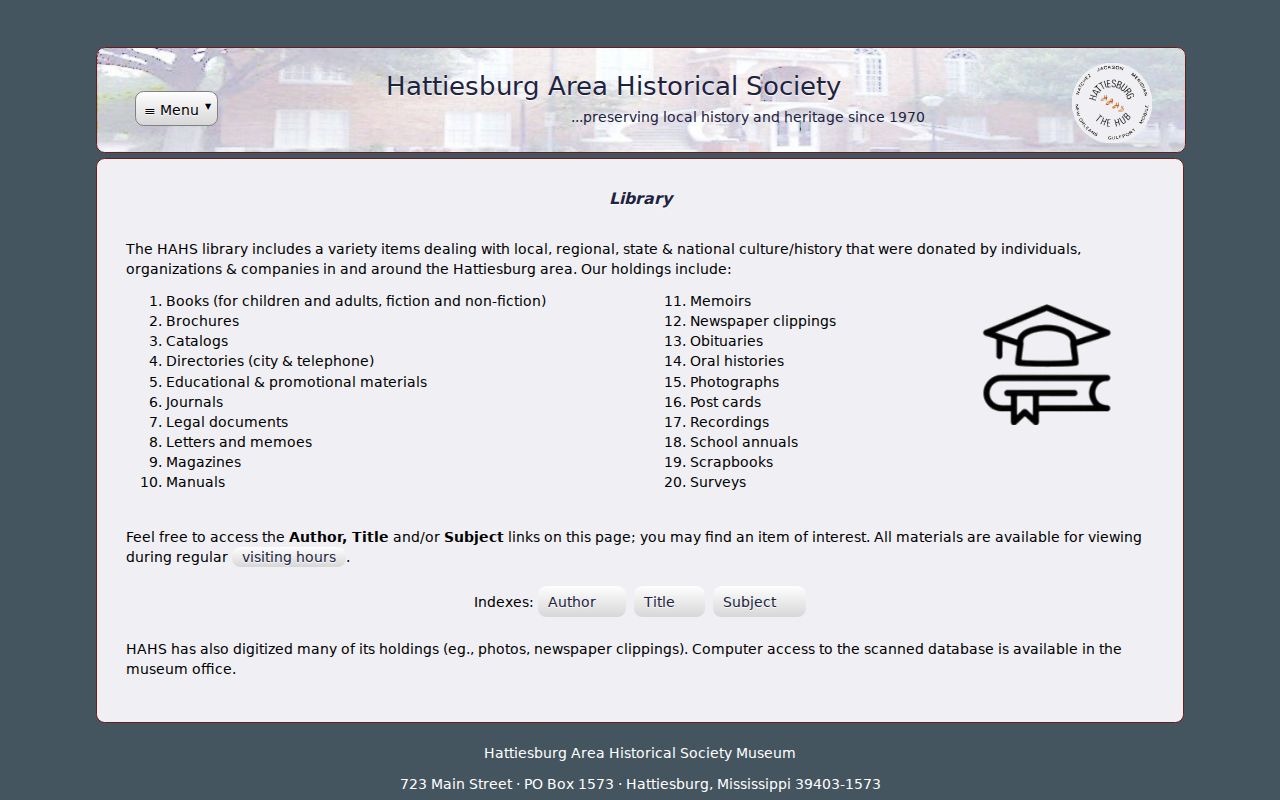
The Hattiesburg Area Historical Society library holdings cover city and telephone directories. The collection also holds obituaries, school annuals, letters, oral histories, photographs, newspapers, and local legal material. HAHS maintains author, title, and subject indexes. Digitized photographs and clippings can be viewed on a computer in the museum office. Its historical newsletter hours are dated context only, so call ahead for a current schedule.
Two more institutions complete the access chain. USM McCain Library & Archives, at 118 College Drive #5148, offers a directory-index tutorial and finding aids. MDAH in Jackson places original Forrest County material in the Archival Reading Room. Self-service microfilm, where available, sits in the Media Room.
Reading a Hattiesburg City Directory Entry
Copy a historical entry exactly as printed. Begin with surname and forename. Then keep the initials, punctuation, spouse or family relation, street and number, and any business affiliation. An occupation can separate two people who share a name. It is a historical descriptor, though, rather than a current claim. Compare the alphabetical entry with nearby entries and the street section. Only then decide whether two similar names identify one person in the residents directory record.
| Name | Exact surname, forename, initials, suffixes, and any alternate spelling printed in the volume. |
|---|---|
| Address | House number and street, retained exactly so it can be checked against the street section and later maps. |
| Family clue | A spouse, widow notation, or other relationship where the directory prints one. |
| Organization | A business, school, congregation, or other affiliation where printed. |
| Occupation | A period occupational notation used only to tell apart historical entries. |
- Criss-cross directory
- An address-ordered section that can lead from a street and number to an occupant entry when the requested year actually includes one.
- Householder index
- An index organized around a household head or address, useful for locating related entries but not proof that every resident was listed.
- Abbreviation key
- The volume's explanation of shortened labels and punctuation. Photograph or transcribe it before interpreting a mark.
Hattiesburg repositories hold city and telephone directories. No official page confirms a complete address-to-occupant criss-cross sequence. Ask HAHS, USM, or MDAH for the specific year, and if a volume lacks a street section, do not call it a reverse directory.
Tracing a Hattiesburg Directory Household
Trace a household in short, dated steps. A name can vanish from the directory for many reasons: a move, a changed spelling, a married name, a listing under a nearby city, or an incomplete volume. Keep those possibilities separate until another record supports one. For a modern address question, the Hattiesburg by-street records offer the current parcel and deed trail, which beats treating an old directory as present-day evidence.
- Locate the earliest plausible entry in the verified 1905, 1910, 1912, or later directory holdings, and copy the printed name, address, family clue, and affiliation.
- Check the next available directory year, preserving old and new street names and noting every address change without assuming its reason.
- Use the same street and ward in the 1910, 1920, 1930, or 1940 census when those census years fit the entry.
- For 1950, use the Census enumeration-district description and its ward or street boundaries. Forrest County has 68 enumeration districts in the 1950 search.
- Move forward through later directories and telephone books, then compare an obituary, cemetery record, probate file, or deed only for the question that source can answer.
Never convert a directory occupant into a title holder. Directories and census entries describe people tied to a household at a point in time; deeds identify the parties to a transfer. That distinction matters in any resident lookup. A dated street spelling and an enumeration district often resolve a same-name puzzle better than a modern map can.
Hattiesburg Directories, Census, and Sanborn Maps
Sanborn fire-insurance sheets give a Hattiesburg directory entry its physical setting. The local bibliography catalogs Hattiesburg sheets for 1890, 1895, 1898, 1903, 1906, 1910, 1915, 1925, 1931, 1931-49, and 1961. The Library of Congress posts a public 1895 scan. A sheet shows the street name, block, building footprint, and nearby uses at the map date. It cannot tell you who occupied the structure. For that, the residents directory still does the work.
Census geography matters just as much. Pair an old directory address with the 1950 census ward and enumeration-district description instead of forcing a modern postal label onto an older record. Street names also change. East Hardy Street reverted to River Avenue effective September 22, 2023, undoing a 1966 rename, so a historical street search needs both names and both dates. When a street search fails, a legal description or plat can bridge the address change.
Research note. A map dates a mapped structure or street setting, while a directory dates a printed name or address. Neither source alone proves every part of a household history.
A Hattiesburg City Directory Story in Print
Story. One printed artifact shows how a residents directory looked in the wild. A digitized 1909 Hattiesburg News page carries a "HATTIESBURG DIRECTORY" block. The block sits amid advertisements, names, and local notices. The Library of Congress scan preserves the entry style of the day. It can supply the newspaper title, the issue date, printed spellings, and any address or business context visible on the page. Surrounding notices add color. It is still not a complete Polk volume.
Later telephone books carry social history too. USM's 1957 telephone-directory item preserves the "Juniper" exchange and party-line conventions. So a phone book works as both an address lead and a record of how neighbors communicated. MDAH's WPA Source Material for Mississippi History, Forrest County offers another bridge. It collects interviews, biographies, Hattiesburg history, Camp Shelby material, newspapers, cemeteries, military records, maps, and photographs from 1936 to 1942. The exact microfilm sits in the MDAH Media Room.
Institutional trails continue into recent decades. USM announced newly processed Waldoff's Department Store records in July 2026. The material spans the mid-1950s through 1994. It includes civic, political, and social documents, photographs, and memorabilia. Search the collection title and its finding aid, not just a person's name. Then anchor any lead to a dated directory, court, deed, census, or custodian record.
Hattiesburg Directory Limits and Follow-Up
The historical shelf has real limits. No full digitized Hattiesburg city-directory page exists online. There is no complete reverse run. There is no continuous publication sequence either. The library's database names and remote-login rules need confirmation at the branch. MDAH's catalog gives a shelf clue, not an online image. These gaps call for a focused request. Name the year, the person or street, and the section needed.
When the online trail stops, go to the holding institution. Hattiesburg Library handles reference help and newspapers. HAHS holds indexed local materials. USM covers Mississippiana and Special Collections. MDAH keeps microform and Forrest County archival records. Preserve the repository, call number or collection name, volume year, page, and date inspected. That record trail makes a later correction possible. It also keeps an annual snapshot from hardening into an unsupported claim.